1. Basic Policy of Information Disclosure
Our basic IR policy is to conduct correct, fair and timely information disclosure to our stakeholders, including shareholders and investors, in accordance with the Financial Instruments and Exchange Act and other relevant laws and the rules for the timely disclosure of issuers of listed securities as defined by the Tokyo Stock Exchange (hereafter “timely disclosure rules”), as well as in accordance with the purpose of our Corporate Governance Code.
2. Subject Disclosure Information and Actions
The Company systematically categorizes material information to be disclosed as shown below and discloses it based on appropriate standards.
- Statutory disclosure information: Disclosure information required by the Financial Instruments and Exchange Act, Companies Act and other laws and regulations, such as securities reports, semi-annual reports, tentative reports, etc.
- Timely disclosure information: Information that may have an important influence on the investment decisions of investors, as defined in the timely disclosure rules by the Tokyo Stock Exchange, such as facts of determination, facts of occurrence and financial information.
- Voluntary disclosure information: Information judged to be useful for shareholders and investors in understanding the Company, although it is not covered in laws and regulations or the timely disclosure rules, such as medium-term financial policies, ESG-related information and annual reports.
3. Information Disclosure System
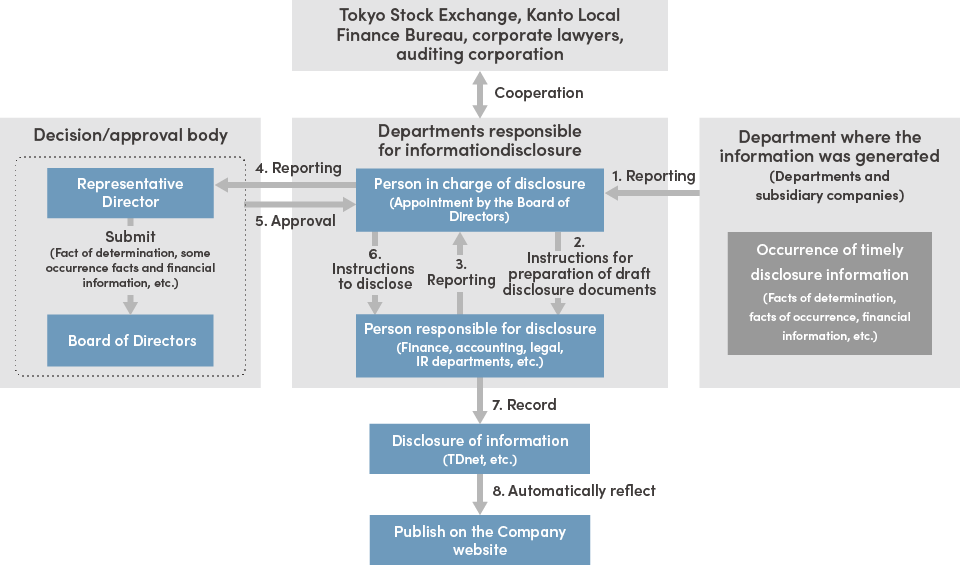
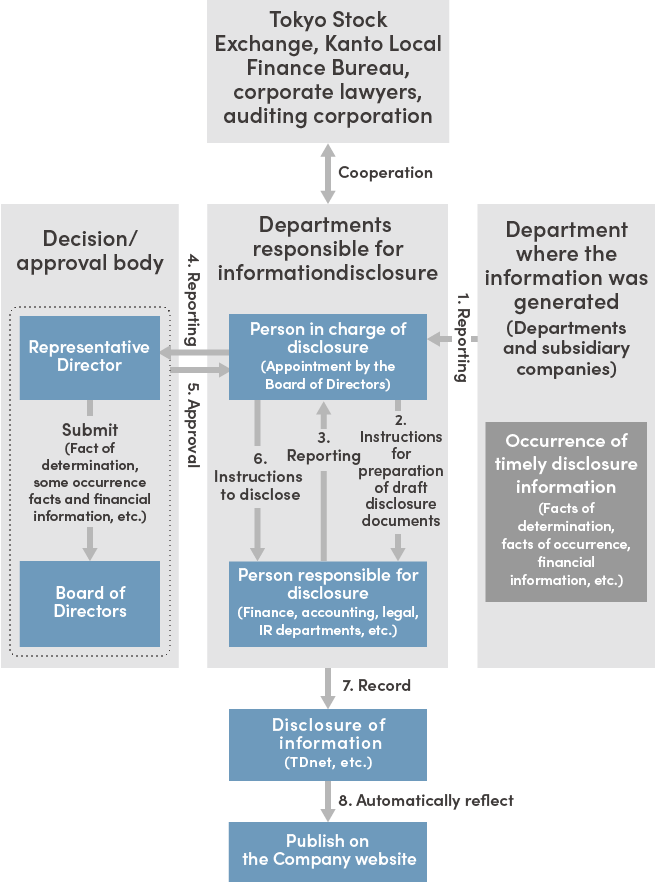
In order to ensure timely, proper and fair information disclosure, the Company clarifies persons responsible for information disclosure and creates a system for correct information gathering and disclosure through coordination with the relevant departments.
4. Methods of Information Disclosure
The disclosure of information for which the timely disclosure rules of the Tokyo Stock Exchange apply will be disclosed on the Timely Disclosure network (TDnet) operated by the Exchange, and in principle will be posted promptly on our IR site. Even after posting on TDnet, the Company strives to provide easier-to-understand information by enriching the content of the IR site. Other information which does not fall under the timely disclosure rules but which is considered important for shareholders to understand the Company will be actively disclosed through the IR site.
5. Quiet period
To prevent the leakage of financial information and secure fairness, a quiet period will be held during one month before the date of the announcement of financial results. During this period, we will refrain from commenting or answering questions regarding our financial results. However, even during the quiet period, if there are important facts that fall under the timely disclosure rules, we will disclose such information immediately in accordance with the purpose of timely disclosure.
6. Dialogue with Shareholders and InvestorsThe Company recognizes that for sustainable growth and the medium- to long-term enhancement of corporate value it is
important to actively conduct dialogues with investors, including shareholders, accurately grasp their expectations, concerns,
requirements, and other feedback concerning the Company, and properly reflect the insights gained in management and business
activities. Under the following policies, the Company is working to promote constructive dialogue with shareholders.
- For general dialogue with shareholders, the department in charge of IR, supervised by the officer who is Director, Executive Officer and CFO, engages in dialogue in principle, and the CEO or CFO also strives to engage in dialogue within reason.
- To achieve constructive dialogue, the Company has created an appropriate response structure under which the department in charge of IR coordinates with the relevant departments for exchanges of opinion and gathering of information within the Company.
- The Company holds regular financial results briefings presented by the CEO and CFO for analysts and institutional investors, as well as briefings for individual investors. The Company also discloses this information on its website.
- The opinions and concerns of investors picked up through the dialogues are summarized by the department in charge of IR, which then reports these appropriately to the Board of Directors and discusses responses with the relevant departments.
- To properly manage insider information, the Company has established the Rules on Timely Disclosure and the Rules on Management of Insider Trading and manage insider information in accordance with the provisions of those rules.
【Status of Dialogue with Shareholders, Etc.】In the fiscal year ended May 31, 2026, the Company actively engaged in IR activities, such as participating in a number of conferences, having the CEO, CFO, and the department in charge of IR visit overseas institutional investors directly, and creating new briefing sessions that enable two-way in-person dialogue. As a result, the number of dialogs with institutional investors and
analysts in the fiscal year ended May 31, 2026 totaled 383, comprising 97 with domestic institutional investors, 225 with overseas institutional investors, and 61 with securities company analysts. In addition, the Company held four financial results briefings for institutional investors and analysts, one IR Day, and four briefing sessions for individual investors, and exhibited twice at IR fairs for individual investors.
7. Proper Control of Insider Information
To properly manage insider information, the Company has established timely disclosure rules and insider trading management rules and strictly manages insider information in accordance with the provisions of those rules.